Should the opener be replaced with the door?
Not automatically, but the install visit is the cheapest moment to do it. The decision hinges on the opener’s age and safety compliance: pre-1993 units without photo eyes should go regardless, and older units may lack the force capacity for a heavier insulated replacement door. A healthy, compliant opener carries over — a competent installer tests it against the new door’s weight rather than quoting a bundle reflexively.
What is R-value and does it matter on a garage door?
R-value measures insulation resistance — higher means less heat transfer through the panels. It matters in proportion to what is behind and above the garage: a conditioned room over the garage or a workshop behind it makes double-digit R-value worthwhile; a detached shell garage does not. Insulated doors are also stiffer and quieter, which is why the spec question deserves a real answer rather than a default.
How dangerous is a torsion spring, really?
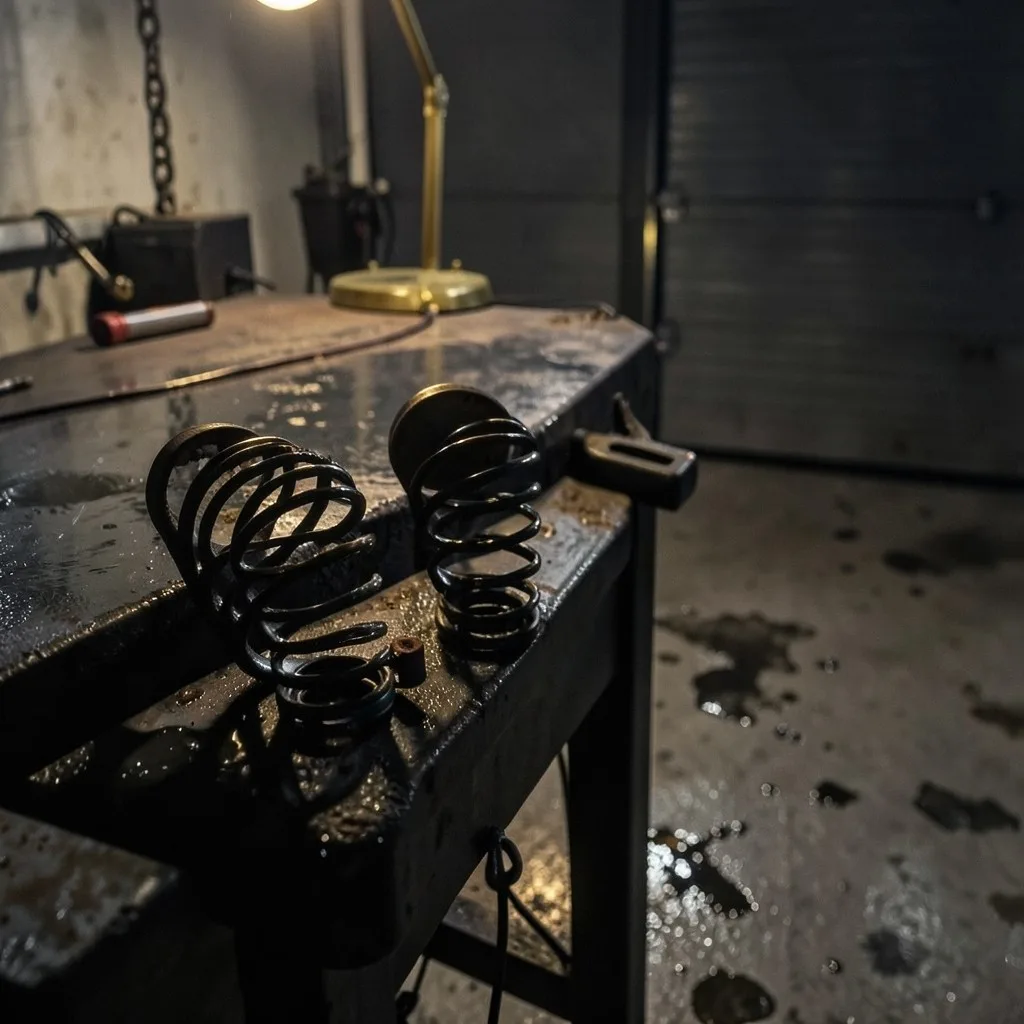
Genuinely dangerous — not liability-boilerplate dangerous. A wound residential spring stores serious mechanical energy held back by two set screws; release it wrong and the winding bar, the cone, or the spring itself moves faster than a hand can. Emergency departments see the results every winter: fractures, amputated fingers, facial injuries. Every safe procedure exists downstream of this fact, and so does the licensing.
The door has two springs and only one broke — what now?
Both get replaced, and it is not an upsell. Springs on the same shaft have identical cycle histories: the survivor is as fatigued as the one that failed, and mixing a new spring with a spent one unbalances the winding across the shaft. The labour is the visit itself — the second spring adds a part, not an appointment. One-spring quotes on two-spring doors are how repeat calls get manufactured.
How long do garage door springs last in American Canyon?
American Canyon’s mild climate is easy on spring steel: 10 to 13 years from a standard set is typical, the top of the national range. With only 2,795 heating degree days a year in Napa County, cycle count — not weather — is what retires springs here, so heavy daily use is the number to watch.
What garage door problems are most common in American Canyon homes?
In American Canyon’s comparatively young housing stock the pattern is cycle-limit failures: builder-spec springs aging out in year 10-plus, sensor and logic-board faults, and impact damage. Rust and legacy-hardware calls are rare; specification quality is the local variable that matters.
Does CA law require a battery backup on my new garage door opener?
It does — across California, American Canyon included. SB-969 has required battery backup on every automatic residential opener sold or installed in the state since July 1, 2019, with a civil penalty per non-compliant unit (Health & Safety Code §§ 19890-19892). The law also blocks connecting a replacement door to a non-compliant opener, which is why installation quotes in Napa County must address the opener even when only the door is changing.
Do I need a permit for garage door work in American Canyon?
It depends on the work. Door installation is frequently permitted work in California: any change to the structural opening triggers a permit everywhere, and a number of cities permit even like-for-like replacements. The local building department's answer is the one that counts — confirm before the door is ordered. Component-level work — spring pairs, cables, rollers, a straight opener swap — is generally exempt from permitting across California jurisdictions. The reliable answer comes from the Napa County building authority — a licensed contractor confirms before ordering a door rather than assuming.
How does the call routing actually work?
Think of the number as a switchboard with one job: putting you on the phone with an independent licensed contractor who actually covers American Canyon. This site publishes the local facts and takes a network referral fee when calls connect — the work, the pricing and the relationship are entirely between you and the contractor.
What will I be asked when I call?
Four things move the call fastest: your ZIP, the door type (sectional or one-piece, single or double), the opener brand, and the symptom in a sentence. With those, dispatch can route to a contractor whose truck stock matches the likely failure — often turning a diagnostic visit into a same-visit repair.
How fast can a pro actually get there?
Response windows are set by the contractor’s live board, not by marketing copy: acute failures get priority and often same-day response in American Canyon; planned work books like any trade visit. The honest window comes on the call — and declining it costs nothing.


 DIAGNOSE