
 $220–$400
Spring pair replacement
The classic. Both springs replaced as a matched pair, wound to the door’s measured weight, balance-tested. The cycle rating on the quote decides when you pay again — ask for it in writing.
Most single-failure garage door repairs land between $150 and $450 nationally: spring pair replacement typically $220–$400, opener repairs $130–$330, cable replacement $150–$260, track straightening $130–$300. Those figures are modelled from published trade wages and parts prices — the method is on this page, and a state table adjusts it for where you live.
// THE NUMBERS UP FRONT
Every number on this page is a bottom-up model, not a scraped average: the U.S. Bureau of Labor Statistics publishes the median wage for the exact trade — occupation 49-9011, Mechanical Door Repairers — and we combine it with a stated loaded labour rate (wage ×2.5–3.5 for insurance, vehicle, overhead and margin, giving a $70–$110/hr shop rate band nationally), stated job-hour assumptions per repair, published-typical parts bands, and a $50–$100 trip charge.
That means you can check the arithmetic, and it means the state table below is real: it re-runs the model with each state’s actual published trade wage instead of a made-up "regional factor". Where a quote lands far outside these ranges, one of the inputs is unusual — the parts tier, the access, the hour of night — and the contractor should be able to tell you which.
National modelled ranges, parts and labour included, standard hours. Every line assumes a single-car or double-car residential sectional door.
| Repair | Typical range | Parts band | Labour assumption |
|---|---|---|---|
| Torsion spring pair replacement | $220–$400 | $60–$130/pair | 1–1.5 hr + trip |
| Extension spring pair (older doors) | $180–$320 | $40–$90/pair | 1–1.5 hr + trip |
| Opener drive-gear kit | $130–$240 | $20–$45 | 0.75–1 hr + trip |
| Photo-eye pair replace/realign | $100–$210 | $0–$50 | 0.5–1 hr + trip |
| Lift cable pair replacement | $150–$260 | $20–$50 | 1 hr + trip |
| Roller full set (10–12) | $140–$280 | $30–$90 | 1 hr + trip |
| Track section straighten/replace | $130–$300 | $0–$80 | 1–1.5 hr + trip |
| Single panel/section swap (profile available) | $250–$700 | $150–$450 | 1.5–2 hr + trip |
| Opener replacement (unit + install) | $350–$700 | $180–$450 | 2–3 hr + trip |
The single biggest honest price difference between markets is what the trade earns there. This table re-runs the spring-pair model with each state’s real published wage for Mechanical Door Repairers.
| State | Trade median wage (49-9011) | Wage index vs US | Spring pair, adjusted |
|---|---|---|---|
| US national | $55,720/yr | 1.00 | $220–$400 |
| CA | $59,560/yr | 1.07 | $235–$430 |
| NY | $60,560/yr | 1.09 | $240–$435 |
| WA | $59,930/yr | 1.08 | $235–$430 |
| MA | $55,770/yr | 1.00 | $220–$400 |
| NJ | $67,150/yr | 1.21 | $265–$480 |
| IL | $65,090/yr | 1.17 | $255–$465 |
| MN | $58,870/yr | 1.06 | $235–$425 |
| TX | $48,190/yr | 0.86 | $190–$345 |
| AZ | $51,760/yr | 0.93 | $205–$370 |
| FL | $50,020/yr | 0.90 | $200–$360 |
| OH | $58,250/yr | 1.04 | $230–$420 |
| TN | $51,790/yr | 0.93 | $205–$370 |
Six levers explain nearly every legitimate quote difference.
A sensor realignment and a panel swap are different classes of job — the component sets the baseline before anything else is discussed. The table above is the map.
The quiet lever: a 10,000-cycle spring versus a 25,000-cycle spring, a builder-grade roller versus a sealed-bearing one. Small money at install time, large differences in when you pay again.
Real and measurable — the state table above shows the actual published wage spread for this trade, roughly ±20% around the national median.
Seized fasteners, rusted brackets and improvised past repairs add labour hours. A door serviced on schedule quotes at the bottom of its range; a neglected one does not.
After-hours, weekend and same-day dispatch carry premiums everywhere in the trade. A failure caught at the "noisy" stage books at standard rates; a failure at the "stuck" stage often cannot wait.
Double doors, high-lift tracks, and finished garages with drywalled ceilings all add time. Weight matters most: heavier doors take heavier springs and more winding.
$220–$400The classic. Both springs replaced as a matched pair, wound to the door’s measured weight, balance-tested. The cycle rating on the quote decides when you pay again — ask for it in writing.
 $130–$240
The sacrificial nylon gear strips to save the motor — white shavings are its signature. A bench repair, not a replacement unit. Insist the balance gets checked too, or the new gear inherits the old schedule.
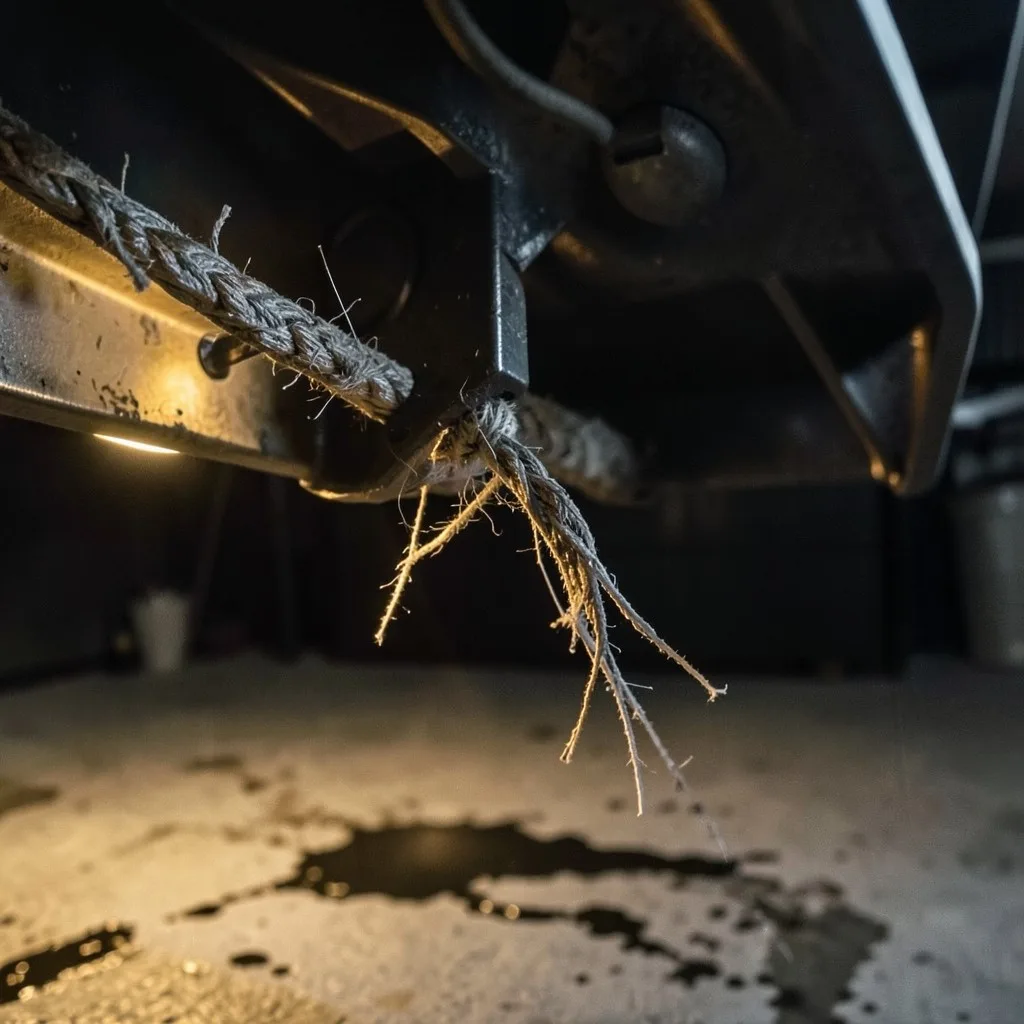 $150–$260
Cables fray at the bottom brackets years before they part. Caught early, this is a routine hour; ridden to failure, it becomes a crooked-door emergency that can take track and panels with it.
Five behaviours separate bottom-of-range invoices from top-of-range ones.
The door type, the opener brand, and the symptom in one sentence put the right parts on the truck. "Bang, then dead weight" gets a stocked spring visit; "it’s broken" gets a diagnostic visit plus a second trip.
Doors telegraph failures — slamming the last foot, grinding, sagging on one side. Repairs booked at the symptom stage price as scheduled work; repairs at the stuck-car stage price as emergencies.
Parts, ratings, labour, trip policy — on paper before authorisation. This single habit defeats the bait-quote pattern that generates most complaint-board stories in this trade.
For any spring work: "what rating are these springs?" A pro answers in numbers. Paying a modest premium for 25,000-cycle steel at replacement time is the cheapest longevity money in the system.
If the visit finds cables at first-fray or rollers past their bearings, replacing them in the same mobilisation costs a part — replacing them next year costs another trip charge and another labour hour.
Repair has a ceiling. These are the crossings.
When a repair estimate crosses roughly half the cost of an equivalent new installed door, replacement usually wins — you are paying old-hardware prices for old-hardware remaining life.
By the third set of springs the whole load path has logged the same cycles: rollers, hinges, cables and sections are all near their own limits. Piecemeal repair stops paying.
One damaged panel with a matchable profile is a repair; a discontinued profile means section sourcing at collector prices, and the whole-door quote is usually the honest one.
Openers without photo-eye entrapment protection fail the federal safety baseline regardless of condition — repair money into one is money into hardware that should retire.
Sixty seconds of preparation, priced in avoided second trips and padded quotes.
Legitimate outfits answer instantly — the fee is ordinary. Evasion on this question predicts evasion on bigger ones; treat it as the screening item it is.
The one-question competence and honesty test for any spring quote. Numbers back = pro; blank or bluster = keep dialing.
Your one-sentence description converts a diagnostic visit into a repair visit — the single biggest self-serve saving on this page.
Ask it of yourself: a door parked DOWN with the car out can usually wait for morning rates. A trapped car or an unsecurable opening cannot. The premium is $50–$150; spend it deliberately.
The bait-quote antidote, requested in advance. Anyone who resists paper before wrenches has told you the business model.
Beyond the state wage table — the local texture inside a metro.
Pre-1980 neighbourhoods (the majority in many covered cities — the Census data rides on every city page) carry legacy hardware: extension conversions, obsolete openers, settled framing. More discovery, more hours.
Compact suburbs amortise the truck roll across near-neighbours; exurban routes put an hour of windshield in every trip charge. Same shop, honest spread.
The first freeze week books every truck in cold climates — scheduled work slides and premiums firm up. The fall tune-up is partly a queue-jumping instrument.
One-contractor towns price like it; five-contractor grids do not. Two phone calls with the questions above is how you find out which market you live in.
Costs organised the way problems actually arrive — by symptom, not by part name.
| What the door is doing | Usual culprit | Typical range |
|---|---|---|
| Bang, then dead weight | snapped torsion spring (pair) | $220–$400 |
| Lifts inches, stops, reverses | fading springs / force limit | $220–$400 or calibration |
| Motor hums, door ignores it | stripped drive gear | $130–$240 |
| Closes, then pops back open | photo-eye circuit | $100–$210 (often free — see guide) |
| Crooked, one side high | cable off drum / snapped | $150–$260 (+track if ridden) |
| Grinding through travel | seized rollers / bent track | $140–$300 |
| Slams the last foot | springs at end-of-life | $220–$400, scheduled |
| Remote range collapsed | battery / interference / receiver | $0–$180 |
| One panel caved | impact damage, profile available | $250–$700 |
| Daylight around the door | seals / geometry | $90–$250 |
Nearly every line in this guide has two prices: the scheduled version — booked at the warning stage, standard hours, bottom of the band — and the emergency version: after-hours dispatch premium ($50–$150), a trapped-car urgency tax on your negotiating position, and whatever collateral damage the failure inflicted on its way down. The hardware is identical; the calendar wrote the difference.
The door almost always offers the choice. Slamming the last foot, grinding at one spot, groaning on cold mornings, drifting crooked — each is an invitation to buy the cheap invoice. The maintenance page on this site exists to catch these at the reading stage; this page exists so that when you do book the visit, every line on the quote already has a name and a range.
Four honest reasons and one dishonest one. Honest: regional labour cost (the state table above shows the real spread), parts tier chosen (a 10,000-cycle spring versus a 25,000-cycle spring), the condition the system arrives in (seized fasteners and improvised past repairs add hours), and timing (after-hours dispatch carries a premium everywhere). Dishonest: the bait quote — a low phone number that triples at the door. The defence against the last one is a written scope before authorisation, every time.
Torsion spring replacement. A two-spring residential door runs roughly $220–$400 nationally for the pair, parts and labour — the model behind that range is a $60–$130 parts band plus about ninety minutes of trade labour and the service call. Springs fail on a fatigue schedule, so this is less "if" than "when": at typical usage a standard set retires in roughly seven to twelve years depending on climate.
Yes — a trip charge in the $50–$100 band is standard practice and usually credits against the repair if you proceed. It covers the truck roll and the diagnosis. Treat a company that refuses to state its trip policy on the phone as a signal; the legitimate trade states it plainly because the fee is ordinary.
The working thresholds: repair costs crossing roughly half the price of an equivalent new installation, a door past 20–25 years with a discontinued panel profile, a third spring failure on the same hardware, or an opener that predates 1993 entrapment protection. Any of those tips the economics toward replacement — the repair-versus-replace section above walks the full framework.
Reputable contractors warrant both parts and labour, and the parts themselves carry manufacturer terms — springs by cycle rating, openers typically 1–10 years by component. A quote should state both warranties in writing. A meaningful spring warranty names the cycle rating; "lifetime" spring warranties usually price the labour of each future swap, so read the terms rather than the headline.
For a narrow, well-described failure — a snapped spring on a standard 16-foot double door — a competent dispatcher can give a tight range. For anything vaguer, honest phone answers come as ranges, and the firm number arrives after eyes on the door. A precise phone price on a vague symptom is the classic setup for at-the-door escalation.
For wear-and-tear failures — springs, cables, openers aging out — no. For sudden covered perils (a storm-thrown branch, a break-in, a vehicle strike under some policies), the door and opener are typically covered as part of the dwelling, minus your deductible. With repair ranges mostly in the low hundreds, claiming rarely beats paying out of pocket unless there is structural damage.
Modestly and mostly through the springs: doubles carry heavier wire and more winding turns, adding roughly $40–$120 to spring work, while opener, eye, cable and roller repairs price nearly identically across widths. The bigger double-door effect is consequence, not cost — a failed double strands two cars and blocks more of daily life, which is why doubles disproportionately generate the emergency-rate version of every repair.
Professional maintenance visits commonly run $80–$180 — inspection, lubrication, calibration, the measured checks. Its economics are straightforward: it converts emergency-rate failures into scheduled-rate line items and catches companion wear (cable fray, roller seizure) at parts-only prices. One prevented after-hours dispatch premium pays for one to two visits by itself — and the dated condition report it produces protects hardware warranties that quietly require documented upkeep. In hard-winter climates, schedule it in fall — ahead of the freeze that turns marginal hardware into the emergency queue.
Sometimes — and the test is what the discount attaches to. Money off a written, itemised scope from a licensed contractor is a discount. A rock-bottom teaser price INSTEAD of a scope (the $29 service call, the $89 spring special) is an acquisition device for the at-the-door renegotiation this page keeps warning about. The paper decides which one you are holding.
Photo-eye realignment — frequently labour-only at the bottom of the trip-charge band, and often free-of-visit entirely via the won’t-close guide on this site: both lenses wiped, brackets squared, both indicator LEDs steady. The most expensive version of the same fault is ignoring it for a month of held-button closes and then paying an emergency rate for the ten-minute fix.