Skip to content
Garage Door Repair Line Nationwide Garage Door Dispatch (800) 555-0167
ZIP 95368 · SALIDA, CA

Garage Door Spring Repair in Salida, CA (Stanislaus County)

Garage door spring repair in Salida is a same-visit job for a licensed pro: the door is secured, both torsion springs are replaced and matched to the door, and balance is verified. In Stanislaus County, springs typically last 10–13 years before letting go.

Much of Salida was built after 1980, so local failures skew toward openers, sensors and builder-grade springs hitting their cycle limit. One call routes you to a licensed Stanislaus County pro.

// CITY DATA FEED

// HAVE READY WHEN YOU CALL

Is your spring near the end of its life in Salida?

Forget the brochure range: spring life is cycles spent against climate load, and this instrument shows where Stanislaus County doors actually land. Original springs older than the low end of the local band are living on borrowed cycles.

10–13 yrs typical spring life · Salida

// THE CYCLE GAUGE · SALIDA

A standard torsion spring is rated 10,000 open-close cycles. A household averaging 4 cycles a day consumes about 1,460 cycles a year — and in Stanislaus County's mild climate (2,534 heating degree days/yr), real spring life lands at 10–13 years, with failures clustering around December. The bright arc is the failure band: past ~72% of rated cycles, breakage risk climbs steeply.

What does compliant garage door work look like in Stanislaus County?

Compliance in Stanislaus County is concrete, not fine print: an opener statute with a real penalty, a licence classification you can look up, and a permit question with a real answer. The cards below carry the citations.

Residential garage door exterior at dusk

SB-969 battery-backup law

California's SB-969 took effect on July 1, 2019: no automatic residential opener may be sold or installed in California without battery backup that keeps the door operable when the electricity fails. Each non-compliant unit sold or installed exposes the seller to a four-figure civil penalty (§ 19892) — and the statute also bars connecting a new door to an opener that fails the requirement.

Contractor licensing

California licenses garage door work under the CSLB D-28 'Doors, Gates and Activating Devices' limited specialty classification. Any job above the state's minor-work exemption threshold requires a CSLB-licensed contractor — and nearly every spring, opener or door replacement clears that threshold.

Permits in Stanislaus County

Door installation is frequently permitted work in California: any change to the structural opening triggers a permit everywhere, and a number of cities permit even like-for-like replacements. The local building department's answer is the one that counts — confirm before the door is ordered. Like-for-like component repair (springs, cables, rollers, opener swap) generally does not require a permit in most California jurisdictions.

Wildfire-zone construction

In California's designated Fire Hazard Severity Zones, exterior construction — garage doors included — falls under the state's wildland-urban interface (WUI) building standards for ember and flame resistance. Homes in mapped zones should confirm listed materials at replacement time.

Wind rating

Wind design in California is mostly unexceptional — ASCE 7 puts typical Risk Category II homes at roughly 91-96 mph ultimate design speed — but the map carries Special Wind Regions in mountain and pass terrain where local authorities can demand more.

What does that noise, stall or slam actually mean?

Before dialing, find your symptom below — knowing the likely cause shortens the call and puts the right parts on the truck the first time.

Separated torsion spring coils on the shaft STOP & CALL

Visible gap in the spring coil above the door

A separated coil is a failed spring, full stop. The counterbalance for a door that can weigh 150–300 pounds is gone. Replacement is by pair on two-spring doors — the survivor shares the broken spring’s cycle count and follows it quickly.

Cable drum with wraps jumped out of their grooves BOOK SOON

Door feels heavy on manual lift

The dead-man test result that matters: heavy means the counterbalance is fading. Every cycle in this state also overworks the opener toward its own failure. Scheduled replacement here is cheaper than the emergency version of the same job plus a gear kit.

Worn steel roller with an ovalled bearing BOOK SOON

Grinding or scraping during travel

Usually a roller or track fault: rollers past their service life stop spinning and start scraping, and a track knocked out of plumb rubs the door edge. In Salida’s older stock the original steel rollers are often decades past their intended life — a full roller swap is routine.

Photo-eye safety sensor with indicator lamp glowing DIAGNOSE

Reaches the floor and pops straight back up

Reversal at floor contact is the entrapment system voting no. Sight down both sensor brackets — a knocked bracket, cobweb or low sun beats a broken part nine times out of ten. If the beam checks clean, the closing-force setting has fallen behind a stiffening door.

Crushed bottom weather seal with light leaking beneath the door BOOK SOON

Drops hard through the final stretch of travel

The counterbalance is no longer matching the door through the bottom of travel — springs at end-of-life have lost torque, or the cables have stretched enough to change the geometry. The slam accelerates wear on every panel joint and is usually the last warning before a spring lets go.

Sectional door sitting crooked in its opening with slack cable STOP & CALL

One side hangs higher — the door sits cocked

A cable has come off its drum or snapped on one side, so the door is lifting unevenly — and the remaining cable plus the tracks are carrying loads they were not designed for. Stop using the door; a cocked door can jump the tracks entirely and wedge or fall.

Roller hanging out of a bent track, panel edge dropped BOOK SOON

Door lifts a few inches, stops, reverses

Weigh the door by hand before blaming electronics: release the trolley and lift. Effort tells the story — a counterbalance losing its torque overloads the safety cutoff long before the motor complains. Recalibration cures the rare genuine drift; tired springs cure nothing until replaced.

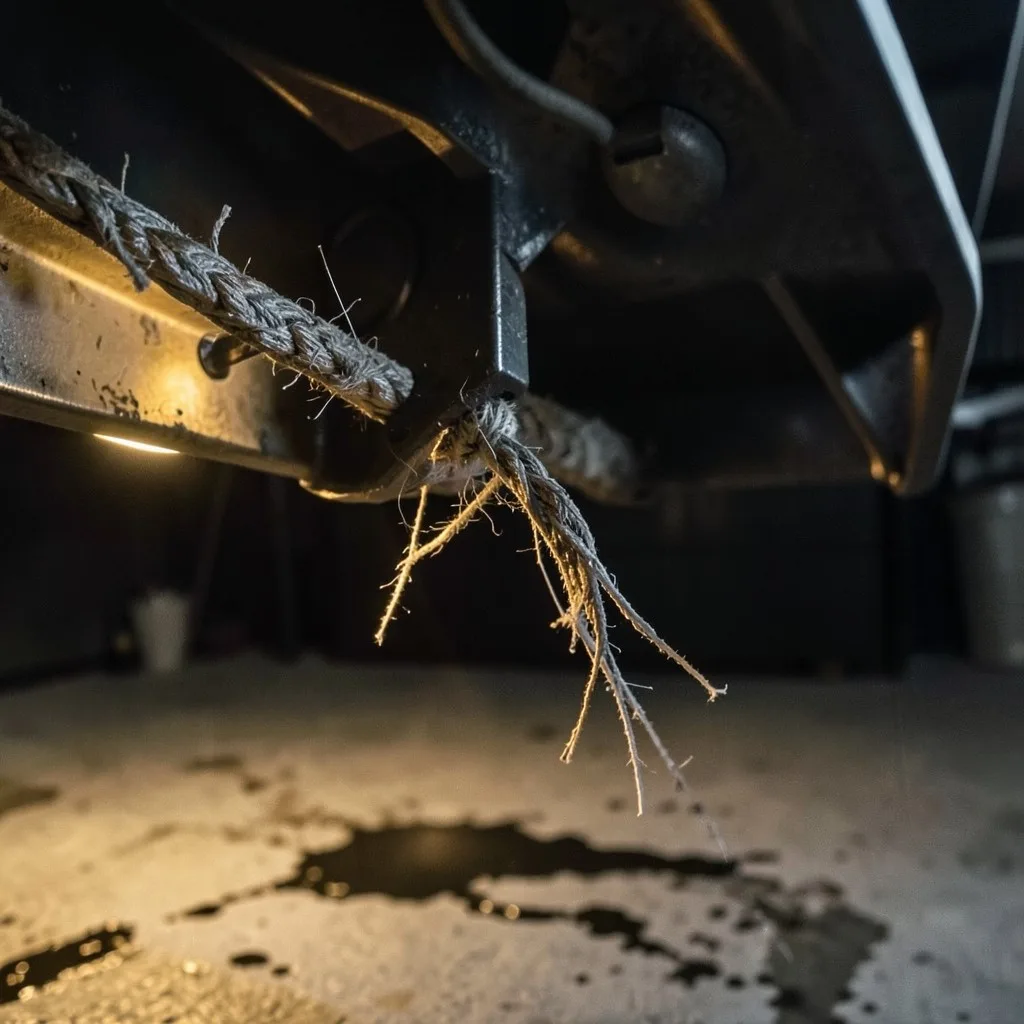
Frayed lift cable at a bottom bracket, strands splaying STOP & CALL

A bang from the garage — now the door will not budge

That crack was stored torque escaping: a fatigued coil parting at its weakest point. Whatever lifted the panels a minute ago no longer exists, so nothing — motor included — should be asked to raise them. Around Salida, sets give out near the 10–13 year mark, December being the cruellest stretch.

Nylon gear shavings dusted over an opener housing BOOK SOON

Motor sound, zero door movement

Listen closer: humming with a stationary curtain of panels points at a sacrificial nylon gear that surrendered — by design — to protect the motor windings. Shavings collect inside the cover as evidence. A bench swap restores drive; weighing the door explains why it happened.

Found your symptom? End it today.

Every hour a spring-dead door sits is an hour of the garage held hostage. Routing takes a minute; a licensed Stanislaus County pro takes the rest. Free to call, free to decline — if no Stanislaus County pro fits your window, you owe nothing.

Call (800) 555-0167

What does a competent spring repair job look like, start to finish?

The job runs in a fixed order for safety reasons. This is what each stage involves, and why it exists.

The call goes out

One call covers it: symptom, door type, opener brand, rough age. Those four answers let routing put the job with a licensed Stanislaus County pro whose truck stock matches the failure — spring inventory in the common sizes, cables, bottom fixtures. Clear answers up front are the difference between a one-visit fix and a parts order.

Work journal and pencil on a garage workbench

The door is made safe

Before any repair, the crew secures the door: clamps below the bottom rollers, opener unplugged, shaft locked against rotation. With a broken spring the counterbalance is gone and the door behaves like dead weight on a track never meant to carry it alone. Making it safe first is not procedure theatre — it is what keeps fingers and vehicles out of the failure path.

Clamps and winding bar securing a garage door system

Repair and re-tension

The failed parts come off and matched replacements go on — springs are always replaced as a pair on a two-spring door, because the survivor has the same cycle count as the one that broke. The new springs are wound to the door’s measured weight, not a chart guess. In Stanislaus County, where spring life runs 10–13 years, matched pairs prevent the classic repeat call six months later.

New torsion spring aligned on the shaft

Balance test and handback

Handback has a pass bar: the door floats at half height on release, one hand lifts it smoothly, the opener relearns its travel, and the reversal test succeeds in front of you. A crew that skips the demonstration is skipping the part that proves the work.

Sectional door balanced at half height

Which checks are safe to do yourself — and which are not?

Most of a garage door is safe to inspect and touch. Two parts of it are not. Here is exactly where that line sits.

SAFE — DO Walk the system with your eyes only: fraying strands at the bottom brackets, a daylight gap in a spring coil, rollers sliding rather than turning. Photograph anything that changed since last month — the picture shortens the service call.
SAFE — DO Wipe the photo-eye lenses and confirm both indicator lights are steady every few months. Misaligned eyes are the most common self-inflicted “broken door”.
SAFE — DO Test balance monthly: pull the release with the door DOWN, lift halfway, let go. A balanced door stays put; a heavy one has fading springs.
PRO-ONLY — DO NOT The coiled steel over the opening holds enough energy to break bones after months of sitting still. No video makes winding-bar work safe for a first-timer; every serious garage door injury statistic starts here.
PRO-ONLY — DO NOT Never detach or handle the lift cables — they are under the springs’ full tension at the bottom brackets, and the bottom bracket bolts are the trap most DIYers do not see.
PRO-ONLY — DO NOT The manual release exists for outages, used with the door DOWN. Pulled mid-travel on a failed spring, it hands hundreds of pounds to gravity with nothing underneath but whatever was underneath.

When do garage doors fail in Salida?

With 2,534 heating degree days a year, Salida hardware lives on a seasonal cycle. This is when each failure mode clusters.

Frost crystals on a torsion spring in a cold garage

Dec – Feb

Cool season

Even in a mild winter, Salida sees its modest failure peak now — cool mornings stiffen aging springs, and December is the month local hardware works hardest.

Meltwater droplets on a garage door track in spring light

Mar – May

Spring

Post-winter reckoning — doors that groaned through the cold get diagnosed now. Roller and hinge wear from the heavy season surfaces as travel noise.

Opener motor head in warm dusty summer light

Jun – Aug

Summer

Peak season for opener faults — board failures and sensor glare rise with garage temperatures. Mechanical hardware coasts; the electronics do not.

Garage at autumn dusk with toolbox staged for a tune-up

Sep – Nov

Fall

Book tune-ups now: the pre-winter service visit catches the springs and cables that would otherwise fail in the December cluster.

Which door and opener types do routed pros service?

Whatever is on the front of your garage, the local pros this line reaches service it. The common types in Stanislaus County housing:

When does replacement beat another repair?

Age, cycle count, panel condition and opener generation decide this — not the person quoting. The framework:

FactorPoints to repairPoints to replace
Door ageYounger than ~15 years, the math favours fixing: standard hardware, available panels.Beyond two decades, scarce parts and compound wear stack up; 1990s-vintage originals in Salida typically sit past the line.
Spring historyFirst spring failure at 10–13 years is normal service, not a verdict on the door.By the third set of springs, the surrounding hardware has aged in parallel; piecemeal repair stops paying.
Panel conditionA single dented section in a current profile swaps economically.When panels fail plural or the profile is discontinued, section pricing usually argues for the whole door.
Opener generationPost-1993 units with photo eyes: repair freely, parts permitting.Openers predating the 1993 entrapment rules belong out of service whatever their mechanical condition.
Operating costA serviced door with sound insulation is cheap to run.Uninsulated panels on a heated garage fight 2,534 heating degree days a year; the insulation upgrade is the payback case.
Aged door panel meeting a new insulated steel panel

What actually drives the price of spring repair in Salida?

The quote you get will vary on a handful of real factors. Knowing them keeps the conversation honest.

Timing

After-hours and same-day dispatch carry premiums everywhere; a fault caught early books at standard rates.

Door size and weight

Doubles outweigh singles, timber outweighs steel, insulated outweighs hollow — and the spring bill scales with every pound. Accurate weight is why good installers measure instead of quoting from a doorway glance.

Which component failed

Springs, openers, cables, panels and track all carry different parts-and-labour weights — the symptom decides the band before anyone quotes.

Access and condition

Seized hardware, damaged track and improvised past repairs add labour — the state the system arrives in is part of the price.

How do you check a California contractor before saying yes?

A few minutes of verification separates the licensed trade from the toll-free vans. Run every contractor — routed or not — through this list.

Trade-practice alignment

DASMA and IDA — the door and dealer associations — publish the safety and installation practices this page describes. Contractors who reference them tend to follow them.

Red flags that end the visit

Immediate full-door replacement pressure on a repairable fault, refusal to state spring ratings, cash-only pricing, no licence number on the vehicle or invoice — any one of these is reason to stop.

Written scope before work

Get the scope in writing before authorisation — parts, ratings, labour. Verbal “while we’re here” additions are the mechanism behind most complaint-board stories in this trade.

The cycle-rating question

One question separates parts-savvy pros from van stock: “what cycle rating are these springs?” Insist the answer — and the rating — appears on the invoice.

Insurance and workers’ comp

Proof of liability insurance and workers’ comp is a yes/no question with paperwork. No certificate, no spring work — that is the trade’s own standard.

Garage Door Spring Repair in Salida — the questions that matter

What does a torsion spring’s cycle rating actually mean?

One cycle is one full open-and-close. Standard residential springs are rated 10,000 cycles; upgrades run 15,000 to 25,000 and beyond. The rating is a fatigue-life estimate for the wire at its working torque — not a warranty, but a good actuarial figure. At four cycles a day, 10,000 cycles is roughly seven years of service. Any quote for spring replacement should state the rating; the difference between tiers is modest against the labour cost of the visit.

Can a garage door with a broken spring be opened at all?

Physically yes, safely no. The spring exists because the door itself can weigh 150–300 pounds; with the counterbalance gone, that full weight is on whatever lifts it. Two adults can raise a spring-dead door in a genuine emergency — car trapped, medical need — using rigid props and never body parts under the door. Outside an emergency, wait for the pro: the off-balance lift is how tracks bend and hands get caught.

What is the difference between torsion and extension springs?

Torsion springs mount on a shaft above the door and counterbalance by twisting; extension springs stretch along the horizontal tracks and counterbalance by extending. Torsion is the modern standard — smoother, longer-lived, and contained on its shaft when it breaks. Extension systems, common on older and lighter doors, require safety cables threaded through each spring so a failure doesn’t whip hardware across the garage. Conversions from extension to torsion are a routine upgrade during replacement.

Why did the spring break in cold weather?

Steel loses ductility as temperature drops, and micro-cracks that were stable all summer propagate under cold-morning load. Meanwhile thickened lubricant and stiffer hardware raise the torque demand on every lift. The combination makes the first sustained cold snap the classic spring-failure window — a pattern visible in service data everywhere winters are real, and the reason pre-winter inspections exist.

How long do garage door springs last in Salida?

Salida’s mild climate is easy on spring steel: 10 to 13 years from a standard set is typical, the top of the national range. With only 2,534 heating degree days a year in Stanislaus County, cycle count — not weather — is what retires springs here, so heavy daily use is the number to watch.

What garage door problems are most common in Salida homes?

In Salida’s comparatively young housing stock the pattern is cycle-limit failures: builder-spec springs aging out in year 10-plus, sensor and logic-board faults, and impact damage. Rust and legacy-hardware calls are rare; specification quality is the local variable that matters.

Does CA law require a battery backup on my new garage door opener?

It does — across California, Salida included. SB-969 has required battery backup on every automatic residential opener sold or installed in the state since July 1, 2019, with a civil penalty per non-compliant unit (Health & Safety Code §§ 19890-19892). The law also blocks connecting a replacement door to a non-compliant opener, which is why installation quotes in Stanislaus County must address the opener even when only the door is changing.

Do I need a permit for garage door work in Salida?

It depends on the work. Door installation is frequently permitted work in California: any change to the structural opening triggers a permit everywhere, and a number of cities permit even like-for-like replacements. The local building department's answer is the one that counts — confirm before the door is ordered. Like-for-like component repair (springs, cables, rollers, opener swap) generally does not require a permit in most California jurisdictions. The reliable answer comes from the Stanislaus County building authority — a licensed contractor confirms before ordering a door rather than assuming.

How does the call routing actually work?

One number, one hop: your call is routed to an independent, licensed garage door contractor serving Salida — selected by ZIP across the 1 covered code(s) here. This site does not perform work or take a cut of your bill; it is compensated by the network when a call connects. Booking decisions stay entirely yours.

What will I be asked when I call?

Four things move the call fastest: your ZIP, the door type (sectional or one-piece, single or double), the opener brand, and the symptom in a sentence. With those, dispatch can route to a contractor whose truck stock matches the likely failure — often turning a diagnostic visit into a same-visit repair.

How fast can a pro actually get there?

Response windows are set by the contractor’s live board, not by marketing copy: acute failures get priority and often same-day response in Salida; planned work books like any trade visit. The honest window comes on the call — and declining it costs nothing.


Which nearby cities carry the same routed line?

One symptom often hides another: these related services cover what Salida calls turn into once a pro looks at the whole door.

// BEFORE YOU DIAL

Expect three questions on the routed call: your ZIP, what kind of door, and when a pro can be there. Answers ready = connected faster.