Skip to content
Garage Door Repair Line Nationwide Garage Door Dispatch (800) 555-0167
ZIP 94582 +1 · SAN RAMON, CA

Garage Door Off-Track Repair in San Ramon, CA (Contra Costa County)

Off-track recovery in San Ramon is a secure-first job: the door gets clamped and unloaded before anything is re-seated, because an off-rail door is suspended load. The routed Contra Costa County pro re-seats, re-anchors and re-gauges, then proves the balance before handback — typically one visit for a clean jump.

Much of San Ramon was built after 1980, so local failures skew toward openers, sensors and builder-grade springs hitting their cycle limit. One call routes you to a licensed Contra Costa County pro.

// LOCAL READOUT

// BEFORE YOU DIAL, GATHER

Is your spring near the end of its life in San Ramon?

The dial below is San Ramon specific — rated cycles, real household usage, and the Contra Costa County climate load, combined into the band local doors actually achieve. Check it against your door age before anything fails.

10–13 yrs typical spring life · San Ramon

// THE CYCLE GAUGE · SAN RAMON

The dial reads cycles, not birthdays: 10,000 is the standard rating, and four openings a day spends about 1,460 a year. Factor in the mild climate over Contra Costa County (2,550 degree days/yr) and local sets realistically deliver 10–13 years — with the failure count peaking each December. Past the bright arc at ~72% of rating, breakage risk climbs steeply.

What do CA law and Contra Costa County rules require?

Compliance in Contra Costa County is concrete, not fine print: an opener statute with a real penalty, a licence classification you can look up, and a permit question with a real answer. The cards below carry the citations.

Residential garage door exterior at dusk

SB-969 battery-backup law

Battery backup stopped being optional in California on July 1, 2019. Under SB-969, every automatic residential opener sold or installed across the state must still run the door with the power out; violations draw a four-figure civil penalty per opener (§ 19892), and installers may not hook a replacement door to a non-compliant unit.

Contractor licensing

The Contractors State License Board issues a dedicated D-28 classification (Doors, Gates and Activating Devices) for this work. Practically every real repair or replacement exceeds the state's minor-work exemption, so the licence question applies to essentially every visit — and the board's public lookup settles it in two minutes.

Permits in Contra Costa County

Door installation is frequently permitted work in California: any change to the structural opening triggers a permit everywhere, and a number of cities permit even like-for-like replacements. The local building department's answer is the one that counts — confirm before the door is ordered. Repairs that replace parts in kind (springs, cables, rollers, openers) typically fall outside permit requirements in California cities.

Wildfire-zone construction

Homes in California's mapped fire-hazard zones answer to the WUI construction standards: exterior components, garage doors among them, must meet ember- and flame-resistance requirements. Zone status is worth checking before any door is specified.

Wind rating

Wind design in California is mostly unexceptional — ASCE 7 puts typical Risk Category II homes at roughly 91-96 mph ultimate design speed — but the map carries Special Wind Regions in mountain and pass terrain where local authorities can demand more.

What is your garage door symptom telling you?

Match what the door is doing to its likely cause — each row below is drawn from what licensed pros actually find behind that symptom in 2000s-era housing.

Roller hanging out of a bent track, panel edge dropped DIAGNOSE

Rollers visibly out of the track on one side

The door has left its geometry — usually after an impact, a slack-cable event or a badly worn roller finally dropping out of a spread track. Whatever is still holding the door is improvising. Do not cycle it, do not pull the release: every command grinds panels against steel they were never meant to touch.

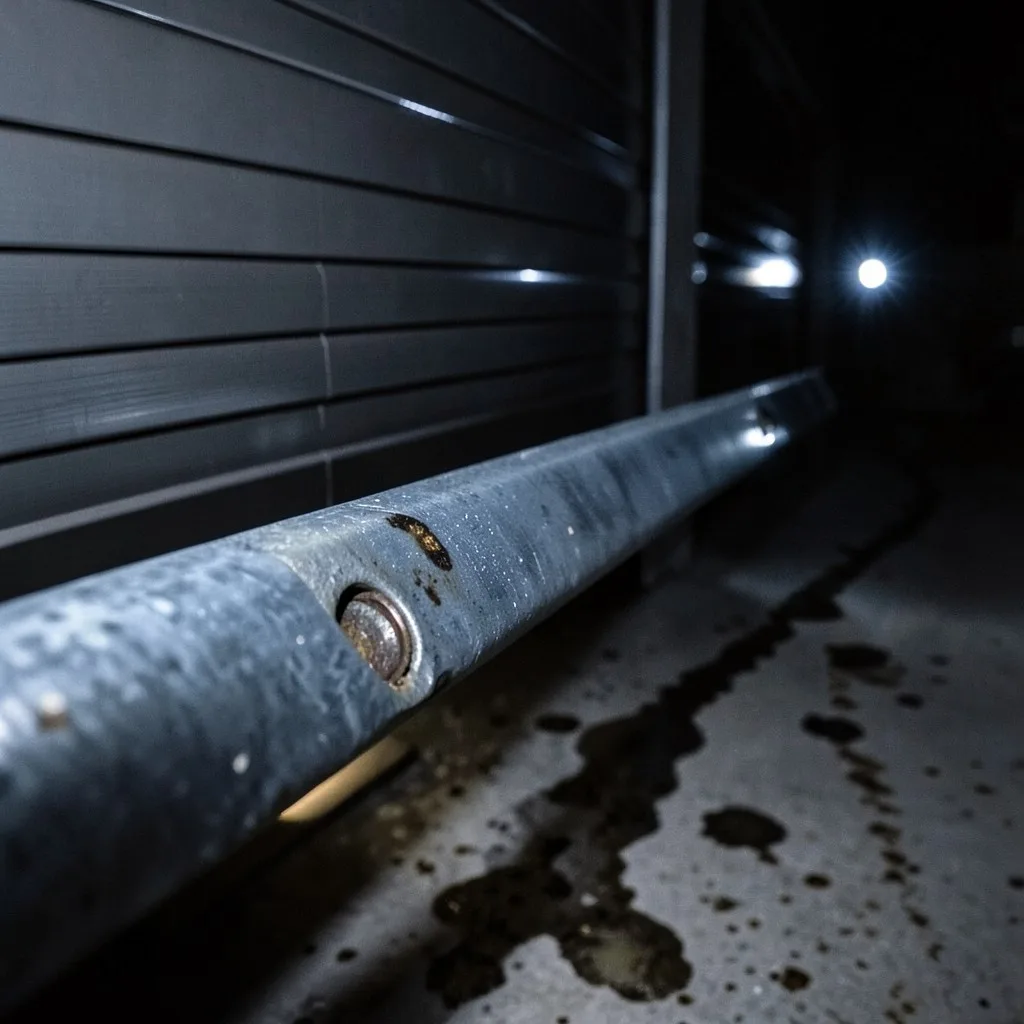
Straight run of garage door track with a roller in the channel DIAGNOSE

Track visibly bent, dented or pulled off the framing

A rail pulled proud of the jamb means the lag screws have worked out of the wood — vibration does it slowly, a bumper tap does it instantly. The fix is re-anchoring into sound framing and re-gauging the pair of rails to the door, wrench-and-level work that takes a pro less than an hour.

Nylon gear shavings dusted over an opener housing BOOK SOON

Motor sound, zero door movement

Motor noise without motion means the power is not reaching the door — stripped drive gear, snapped chain or belt, or a disengaged trolley. On 2000s-era openers the nylon gear is the usual casualty and is a standard repair, cheaper than the replacement unit a cold call might push.

Garage door remote with a worn button on a workbench DIAGNOSE

Wall button dead but the remote works (or the reverse)

This splits the diagnosis cleanly. Working remote + dead wall button points to the low-voltage wire run; working button + dead remote points to pairing or the receiver board. Either way the motor and drive are healthy — a short, cheap visit for a pro with a meter.

Cable drum with wraps jumped out of their grooves BOOK SOON

Door lifts a few inches, stops, reverses

Two suspects: a failing spring making the door heavier than the opener’s force setting allows, or travel/force calibration drift. The tell is the manual test — if the door is hard to lift by hand, the springs are the issue and the opener is protecting itself.

Snapped torsion spring with a visible gap between coil halves STOP & CALL

A bang from the garage — now the door will not budge

Classic torsion spring failure — the bang is the spring letting go, and the door instantly becomes dead weight the opener cannot and should not lift. Do not pull the red release with the door up. Springs here last roughly 10–13 years, and the failure clusters around December.

Crushed bottom weather seal with light leaking beneath the door BOOK SOON

Drops hard through the final stretch of travel

Fading springs. As torsion springs wear, they lose the stored torque that eases the door down, and gravity wins the final section of travel. With local spring life at 10–13 years, a slamming 2000s-era door is typically running on its original set — inspection-due.

Sectional door sitting crooked in its opening with slack cable STOP & CALL

One side hangs higher — the door sits cocked

A drum has let its cable escape — or the cable itself parted at the fray point — and now one jamb is doing two jambs of work. Racking follows, then a jumped track. Park the opener and keep hands clear; the surviving side is under double tension.

Worn steel roller with an ovalled bearing BOOK SOON

Grinding or scraping during travel

Metal-on-metal contact somewhere in the travel path — a bent track section, a seized roller dragging instead of rolling, or a door rubbing its stop moulding after the tracks drifted. Left running, the wear compounds: seized rollers oval their stems and take hinges with them.

Found your symptom? End it today.

A snapped spring does not improve overnight — and the second spring is carrying the load alone. One call routes you to a licensed Contra Costa County pro. The call commits you to nothing: no fee, no booking pressure, no callback list.

Call (800) 555-0167

What happens after you call about off-track repair in San Ramon?

What happens after you call, stage by stage — the version a good contractor would describe unprompted.

The call goes out

One call covers it: symptom, door type, opener brand, rough age. Those four answers let routing put the job with a licensed Contra Costa County pro whose truck stock matches the failure — spring inventory in the common sizes, cables, bottom fixtures. Clear answers up front are the difference between a one-visit fix and a parts order.

Work journal and pencil on a garage workbench

The door is made safe

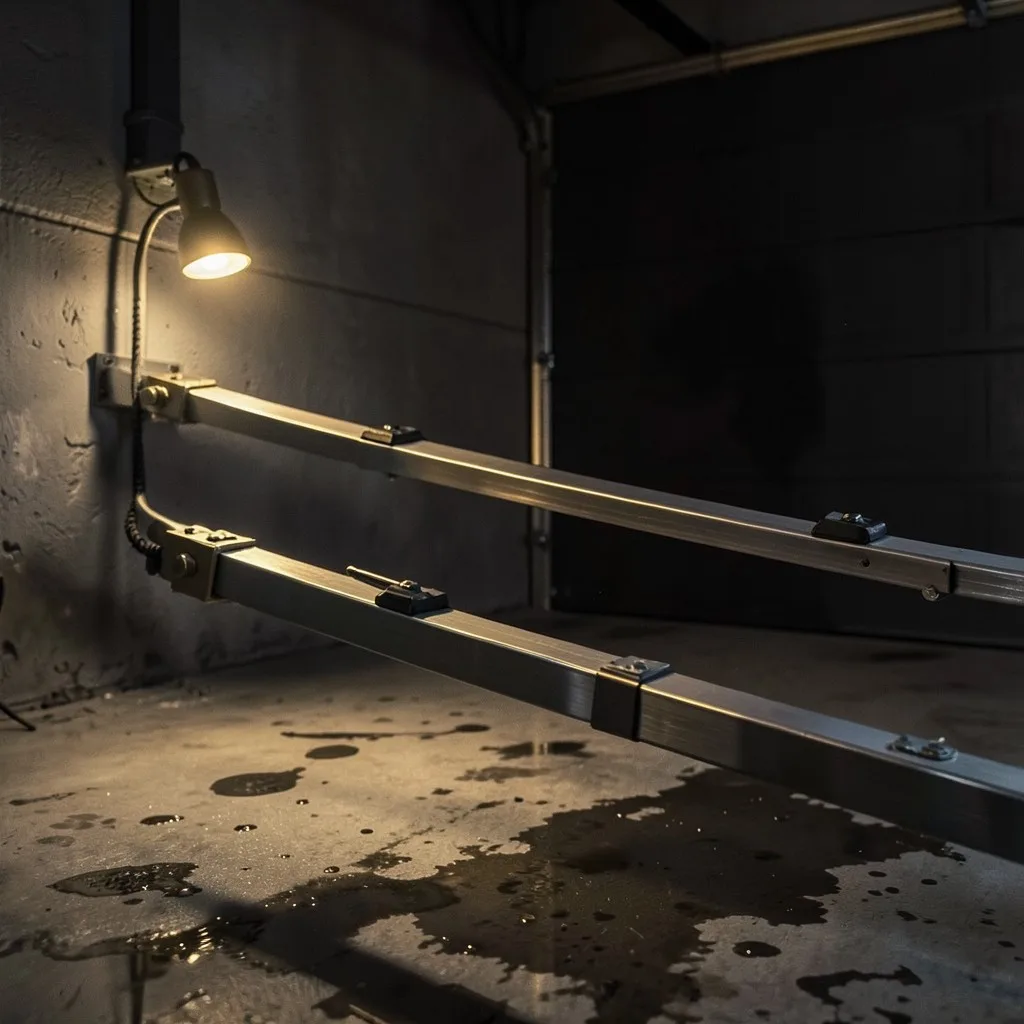
Before any repair, the crew secures the door: clamps below the bottom rollers, opener unplugged, shaft locked against rotation. With a broken spring the counterbalance is gone and the door behaves like dead weight on a track never meant to carry it alone. Making it safe first is not procedure theatre — it is what keeps fingers and vehicles out of the failure path.

Clamps and winding bar securing a garage door system

Repair and re-tension

The failed parts come off and matched replacements go on — springs are always replaced as a pair on a two-spring door, because the survivor has the same cycle count as the one that broke. The new springs are wound to the door’s measured weight, not a chart guess. In Contra Costa County, where spring life runs 10–13 years, matched pairs prevent the classic repeat call six months later.

New torsion spring aligned on the shaft

Balance test and handback

Handback has a pass bar: the door floats at half height on release, one hand lifts it smoothly, the opener relearns its travel, and the reversal test succeeds in front of you. A crew that skips the demonstration is skipping the part that proves the work.

Sectional door balanced at half height

What can you touch safely on this system — and what never?

Two components in this system — the torsion springs and the cables under their load — are genuinely dangerous. The list below is the line between homeowner checks and pro work.

SAFE — DO Look and listen: fraying cables, gaps in spring coils, rollers that slide instead of spin, new noises in cold weather. Eyes-only inspection is safe and useful.
SAFE — DO Give the sensor pair a monthly ten seconds: lenses clean, brackets square, both indicator lamps steady. It is the only safety component built for owner care, and a nudged bracket is the cheapest fault in the whole system.
SAFE — DO Run the manual balance check monthly — door down, release pulled, one-hand lift to half height. Drift from “holds steady” is your early warning.
PRO-ONLY — DO NOT Never adjust, unwind or remove a torsion spring. The stored energy in a wound spring is in lethal range, and winding bars in untrained hands do not make it safer.
PRO-ONLY — DO NOT Leave the cables and bottom brackets alone. Both are loaded by the springs even when the door looks at rest; removing the wrong bolt releases that load into the room.
PRO-ONLY — DO NOT Do not pull the emergency release with the door open — a spring-dead door will free-fall. Release only with the door fully closed.

Which months are hardest on San Ramon doors?

With 2,550 heating degree days a year, San Ramon hardware lives on a seasonal cycle. This is when each failure mode clusters.

Frost crystals on a torsion spring in a cold garage

Dec – Feb

Cool season

Even in a mild winter, San Ramon sees its modest failure peak now — cool mornings stiffen aging springs, and December is the month local hardware works hardest.

Meltwater droplets on a garage door track in spring light

Mar – May

Spring

Post-winter reckoning — doors that groaned through the cold get diagnosed now. Roller and hinge wear from the heavy season surfaces as travel noise.

Opener motor head in warm dusty summer light

Jun – Aug

Summer

Peak season for opener faults — board failures and sensor glare rise with garage temperatures. Mechanical hardware coasts; the electronics do not.

Garage at autumn dusk with toolbox staged for a tune-up

Sep – Nov

Fall

Book tune-ups now: the pre-winter service visit catches the springs and cables that would otherwise fail in the December cluster.

Does coverage include your door and opener type?

Coverage spans the full residential range found in 2000s-era and newer San Ramon homes:

What actually drives the price of off-track repair in San Ramon?

What drives the cost of this work — the factors, not the figures. For researched ranges, see the cost guides.

Timing

Clock and calendar both bill: overnight and same-day dispatch carry premiums everywhere, and the December rush concentrates demand. The fall inspection is, financially, the cheapest emergency call never made.

Door size and weight

Double doors need heavier springs and more of the crew’s time than singles; wood and insulated doors weigh more than builder-grade steel.

Which component failed

The failed part sets the baseline: a sensor realignment and a full spring pair replacement are different classes of job.

Access and condition

Seized hardware, damaged track and improvised past repairs add labour — the state the system arrives in is part of the price.

Which verifications protect you from the bait-and-switch vans?

Trust is checkable in CA. These are the specific verifications a San Ramon homeowner can run before authorising work.

Trade-practice alignment

Ask whether the work follows DASMA guidance (the industry’s technical standards body). The answer is less important than whether the question lands as familiar.

Red flags that end the visit

Walk away from: unsolicited whole-door quotes for a spring symptom, prices that moved dramatically from the phone, missing licence numbers, or a crew that will not put the scope in writing.

Written scope before work

Authorise nothing verbal. The classic complaint-board sequence is a friendly phone figure, a grim on-site discovery, and a tripled invoice — a written scope with parts and ratings breaks the sequence before it starts.

The cycle-rating question

Ask what cycle rating the replacement springs carry. A pro answers in numbers (10,000 / 15,000 / 25,000). A quote that cannot name the rating is a quote for unknown parts.

Insurance and workers’ comp

Proof of liability insurance and workers’ comp is a yes/no question with paperwork. No certificate, no spring work — that is the trade’s own standard.

Garage Door Off-Track Repair in San Ramon — the questions that matter

Can bent track be straightened, or does it need replacement?

Minor lips and dents get dressed with proper forming tools; genuinely bent sections get replaced, and that is the better news than it sounds. Track is inexpensive roll-formed steel sold by the section — swapping a damaged run costs far less than the panel and roller damage a “straightened” kink causes over the following year. What matters more than the steel is the re-alignment: gauge, plumb and parallel re-set to the door, which is the measured part of the visit.

The car hit the door — is that an off-track repair or something bigger?

It is an inspection first, because impact damage travels. The visible fault may be a jumped roller or creased rail, but the force went through panels into hinges, rollers, track anchors and sometimes the jamb framing — a door that folded around a bumper often has damage two components away from the dent. A proper assessment prices the honest scope before any re-seat: sometimes it is an hour of track work, sometimes the impact wrote off a panel, and pretending otherwise just phases the discovery.

How long does an off-track recovery actually take?

A clean jump — rollers out, track sound, cause identified — re-seats in one to two hours including the cause correction and the balance test afterward. Add time when the event bent track sections (swap and re-gauge), damaged rollers (replace the set, not the one), or ran under power long enough to crease a panel edge. The one version that never happens fast is the door that kept being cycled after the jump; every extra command adds a line to the scope.

Will the door be weaker after it has jumped the track once?

Not if the recovery was done as a system. Steel rails re-gauged to spec, sound anchors, fresh rollers where the old ones contributed, and a verified balance leave the door mechanically indistinguishable from before the event. What creates repeat offenders is partial recovery: the roller pushed back into a rail that is still spread, the cause never named. Ask the tech what caused the jump — a confident answer is the difference between a repair and a rehearsal.

How long do garage door springs last in San Ramon?

San Ramon’s mild climate is easy on spring steel: 10 to 13 years from a standard set is typical, the top of the national range. With only 2,550 heating degree days a year in Contra Costa County, cycle count — not weather — is what retires springs here, so heavy daily use is the number to watch.

What garage door problems are most common in San Ramon homes?

In San Ramon’s comparatively young housing stock the pattern is cycle-limit failures: builder-spec springs aging out in year 10-plus, sensor and logic-board faults, and impact damage. Rust and legacy-hardware calls are rare; specification quality is the local variable that matters.

Does CA law require a battery backup on my new garage door opener?

It does — across California, San Ramon included. SB-969 has required battery backup on every automatic residential opener sold or installed in the state since July 1, 2019, with a civil penalty per non-compliant unit (Health & Safety Code §§ 19890-19892). The law also blocks connecting a replacement door to a non-compliant opener, which is why installation quotes in Contra Costa County must address the opener even when only the door is changing.

Do I need a permit for garage door work in San Ramon?

It depends on the work. Door installation is frequently permitted work in California: any change to the structural opening triggers a permit everywhere, and a number of cities permit even like-for-like replacements. The local building department's answer is the one that counts — confirm before the door is ordered. Repairs that replace parts in kind (springs, cables, rollers, openers) typically fall outside permit requirements in California cities. The reliable answer comes from the Contra Costa County building authority — a licensed contractor confirms before ordering a door rather than assuming.

How does the call routing actually work?

One number, one hop: your call is routed to an independent, licensed garage door contractor serving San Ramon — selected by ZIP across the 2 covered code(s) here. This site does not perform work or take a cut of your bill; it is compensated by the network when a call connects. Booking decisions stay entirely yours.

What will I be asked when I call?

Four things move the call fastest: your ZIP, the door type (sectional or one-piece, single or double), the opener brand, and the symptom in a sentence. With those, dispatch can route to a contractor whose truck stock matches the likely failure — often turning a diagnostic visit into a same-visit repair.

How fast can a pro actually get there?

Same-day dispatch is common in San Ramon for morning calls on acute failures — stuck doors and snapped springs get priority. Scheduled work (installs, maintenance, commercial scopes) books by appointment. The routed contractor quotes their real window on the call; nothing here promises times the local schedule cannot keep.


What does coverage look like around San Ramon?

One symptom often hides another: these related services cover what San Ramon calls turn into once a pro looks at the whole door.

// BEFORE YOU DIAL

Expect three questions on the routed call: your ZIP, what kind of door, and when a pro can be there. Answers ready = connected faster.