
Opening Without Power, Without Getting Hurt
Pull the red release cord — but only with the door fully closed — then lift the door by hand from the bottom, keeping fingers on the face of the panel, and prop nothing under it you would not trust with its full weight. From outside, the emergency key release does the same job. Every step, the one hard rule, and re-engagement are below.
// THE NUMBERS UP FRONT
What is the exact sequence?
Ninety seconds, done right.
Confirm the door is fully closed
Walk to the door and look. If it is up or partly up, do NOT pull the release — go to the stuck-open procedure in the FAQ instead. The entire safety of this operation lives in this one glance.
Pull the red cord straight down
The red handle hangs from the trolley on the opener rail. A firm straight-down pull disconnects the door from the drive — you will feel the lever snap over. (Pulling it toward the door on some units holds the release open for manual mode; straight down is the standard disconnect.)
Lift from the bottom, palms on the face
Grip the handle or the bottom edge with palms flat against the panel face — never fingers into the joints between sections, which scissor as the door bends over the track radius. One smooth lift to fully open; the door should stay put there on its own.
Move the car, close the door, keep it down
Lower it smoothly by the same grip — it should settle, not slam. Through the outage, treat it as a manual door: fully open or fully closed only, and secured (slide lock or a track clamp from inside) whenever you leave the house.
Re-engage when power returns
Door DOWN, press the wall button once: the carriage runs to the trolley and clicks in on modern units. Watch one full cycle; odd travel or a hard slam at the floor means limits want recalibration — book it rather than repeating it.
What is the red cord actually doing?
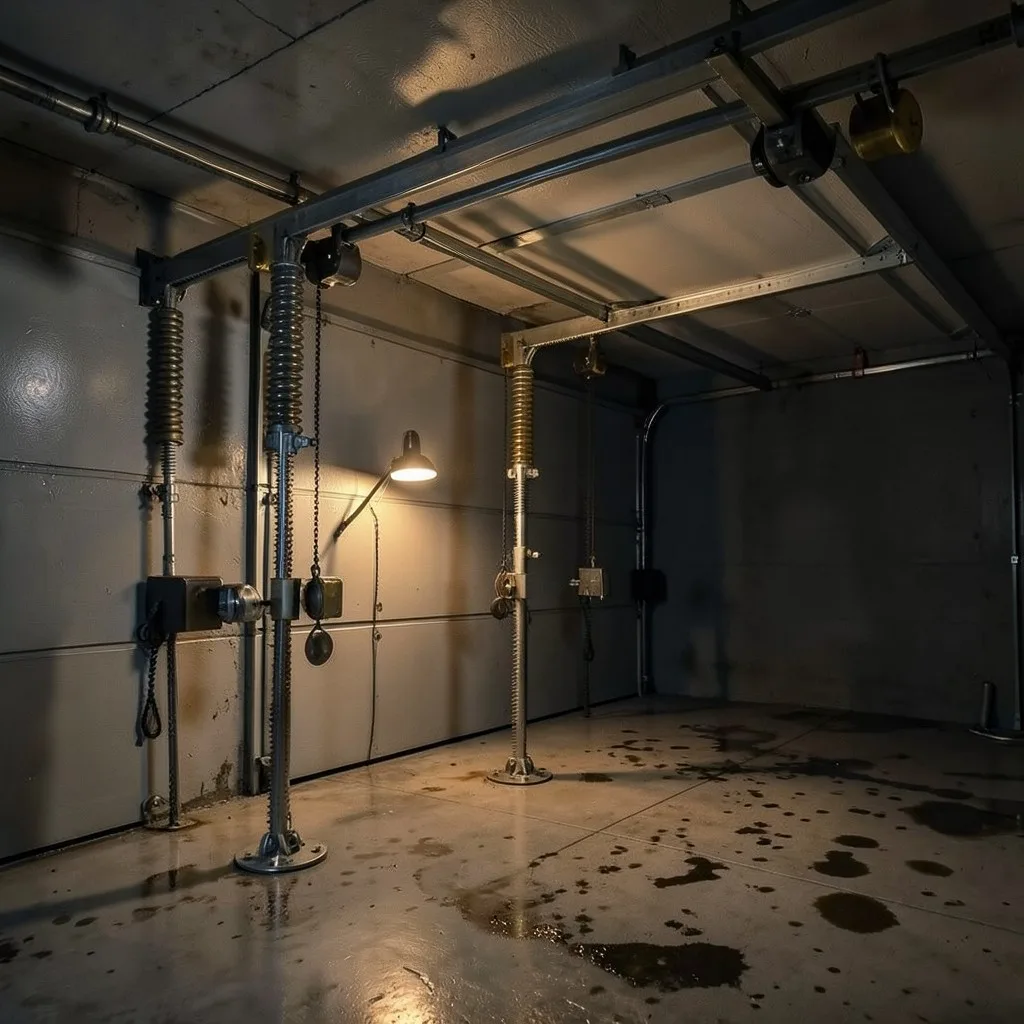
The cord operates a latch on the trolley — the shuttle that clips the door’s arm to the opener’s moving carriage. Released, the opener and door part company completely: the motor can run without moving the door, and the door can move without the motor. Nothing about the release touches the springs, and that is the point — the counterbalance keeps doing all the real lifting, which is why a healthy door feels light by hand.
It is also why the door-down rule exists. The release does not make the door heavy; a dead spring makes the door heavy, and the release is simply the moment you find out. Pulled with the door closed, that discovery costs nothing — the door is already resting on the floor, and a too-heavy manual lift tells you to stop and call. Pulled with the door up, the same discovery arrives at free-fall speed. Same cord, same spring — the door position decides which story gets told.
The rules that keep this boring
What should the outage teach you?
Find your key release now
If the garage has no service door, confirm the outside key cylinder exists and the key is on your ring — not taped inside the garage it unlocks. Ten seconds of checking beats discovering its absence in the rain at midnight.
Test the release annually
Pull it (door down), lift, re-engage — as part of the same monthly balance habit the maintenance page describes. A release that has never been operated is stiff exactly when it matters.
Price the battery backup
One outage with a trapped car usually settles the question. Statutory in California on new installs; a modest line inside the installed-opener ranges everywhere else.
Log what felt wrong
Heavy lift, uneven rise, slam at the floor — whatever the manual operation revealed goes in the service call. The outage was an unplanned inspection; spend its findings.
Two more edge cases worth thirty seconds
Power died mid-travel
The door is parked wherever the outage caught it. If it stopped partly open: treat it as the stuck-open case — support it before any release, or simply leave it be until power returns if the opening can wait. Openers hold position when dead; gravity only enters with the release cord.
Release cord snapped or missing
Ageing cords do break. The release LEVER on the trolley still works — reached with a stepladder and a firm hand, door down, exactly as the cord would have pulled it. Replace the cord at the next visit; it costs pennies and exists for the no-ladder moment.
How long does a battery backup actually run a door?
What the backup tier really buys, in cycles and days — the honest capacity math.
| Scenario | Typical capacity | What it means |
|---|---|---|
| Fresh backup, normal use | ~20–40 full cycles | a day or more of ordinary coming and going |
| Backup at 1–2 years old | reduced, still serviceable | batteries are consumables — test twice a year |
| Extended multi-day outage | ration to essential cycles | the manual release remains the deep reserve |
| California new installs | mandatory since 2019-07-01 | SB-969: a wildfire-outage lesson written into law |
| No backup at all | zero — this page is the plan | the release cord and the rules above |
Three outage scenarios, three right answers
Storm outage, car inside, work at 8am
The main sequence on this page: door down, release, manual lift, car out, door down again, slide lock. Ninety seconds, no tools, no drama.
Detached garage, no service door, key inside
The outside key release is the answer — and if this sentence just revealed you do not have one, that is the to-do this page exists for.
Door died OPEN in the rain
The supported stuck-open procedure: clamps on both tracks first, inspection second, two adults lowering third. If anything about the door looks wrong, it stays clamped and the call gets made.
Frequent-outage neighbourhood
Stop treating outages as events: battery backup at the next opener replacement converts this entire page into a non-event, for less than the cost of one emergency visit.
The outside key release — the part most garages are missing
Detached garages and garages without a service door have exactly one non-destructive way in during an outage: a small round lock cylinder near the top centre of the door face, whose key pulls a cable tied to the trolley release. Turn, pull, and the door is in manual mode from the street side — same disconnect as the red cord, different handle. If your garage has one, the time to confirm the key is on your ring is now, not mid-outage.
If it does not have one, note two things. First, installation is a modest add-on at any service visit — a drilled cylinder, a cable, ten minutes of routing. Second, its absence is why locked-out owners end up bending top panels with pry bars or fishing for the release cord with coat hangers through the weather seal — both of which cost far more than the cylinder, and the coat-hanger trick is precisely the burglary technique a properly shielded release is designed to defeat. Fit the hardware; skip the improvisation economy.
After the power returns: the five-minute closeout
Door down, then one button press
Re-engagement wants the door closed. One wall-button press runs the carriage home until it clicks into the trolley — modern units self-latch; older ones want the cord pulled toward the door first.
Watch one full cycle end to end
Power events scramble some units’ travel memory. Watch a complete open-close: hesitation, new noises, a slam at the floor or a gap at the header all mean the limits want attention.
Re-run the reversal test
Board under the door, close, confirm the retreat. Ninety seconds to prove the safety circuit rode through the outage intact — surge-adjacent power events are exactly when boards develop quirks.
Check the clocks and codes
Openers with timers or motion lights may need resetting, and any keypad running low batteries tends to die during the same week as the outage that stressed it. Two minutes now beats a mystery next month.
File what the manual days taught
Heavy lift? Uneven rise? Grinding at one spot? The outage ran an accidental full inspection — put its findings in a service call while they are fresh.
The stuck-OPEN procedure, spelled out
The one legitimate exception to the door-down rule — done with supports, or not at all.
Support the door before anything
Locking pliers or C-clamps hard onto the vertical track directly under the bottom roller — BOTH sides — so the door physically cannot descend. No props under the door itself; supports grip the track, out of the fall path.
Inspect before you commit
Crooked door, one slack cable, coil gap in a spring, or a bang earlier in the day? Stop here: leave it clamped and call. Those are stored-energy failures, and lowering a compromised door by hand is how they injure people.
Release with hands ON the door
Two capable adults, one per side, gripping the bottom section face. A third person (or one careful hand) pulls the red cord. The door’s weight arrives the moment the trolley lets go — you want it arriving into prepared grips, not by surprise.
Walk it down, evenly
Lower in unison, keeping the bottom edge level — a door lowered one-sided can rack and jump its tracks. It should get lighter as the springs take up load through the arc; if it fights downward or drops, let it settle and keep body parts clear.
Leave it down, then diagnose
Door closed is the safe stable state. Remove the clamps, keep it manual until power returns, and treat anything abnormal you felt — weight, tilt, grinding — as the service call’s opening sentence.
What should be in the outage playbook?
Five minutes of preparation converts this whole page from emergency reading to a checklist you already ran.
| Item | Why it matters | When |
|---|---|---|
| Know your release cord and test it yearly | a lever operated once a year works when it matters | with the monthly balance test |
| Outside key release installed & key on ring | the only inside access when there is no service door | check TODAY, install at next service |
| Slide lock present and working | released doors have no opener holding them shut | check now — many doors lack one |
| Flashlight staged in the garage | the release gets pulled in the dark, on a ladder-free reach | now |
| Battery backup on the next opener | deletes this entire page for a day-plus of outage | at replacement time |
| Manual-mode house rule for kids | no opener means no photo eyes and no force limit | family briefing |
Living manual for days — what changes?
Extended outages turn the door into pure hardware. Four adjustments cover it.
Two stable states only
Fully open or fully closed — never parked mid-travel. A half-open door is held by nothing but spring balance, and balance is a maintenance state, not a guarantee.
Lock it like a door
The opener normally acts as the lock; released, it does not. Use the slide lock, or clamp the track above a roller from inside each night. An unlocked released door lifts from outside by hand.
Adults operate, children watch
Every safety system — force ceiling, photo eyes, reversal — is offline in manual mode. The 300-pound machine is exactly as forgiving as it looks.
Log the feel
Manual operation is an accidental inspection: effort, evenness, sounds. Whatever felt wrong goes verbatim into the post-outage service call — it is diagnostic data you paid nothing for.
Manual release — the questions that matter
Why is “door down first” the one unbreakable rule?
Because the release cord disconnects the door from the opener’s drive — and if a spring has failed without you knowing, the opener was the only thing holding the door up. Pull the release with the door raised in that state and it free-falls with its full 150–300 pounds. With the door closed, gravity is already done: nothing can fall. Every injury story about the red cord starts with a door that was up.
The door is stuck OPEN with a car trapped underneath the opening — now what?
This is the one scenario where the release gets pulled with the door up, and it should not be done casually: the door must be supported before release — locking pliers clamped onto the track under the bottom roller on BOTH sides, or two capable adults physically holding the door. Release, lower slowly and evenly by hand, then leave it down. If anything about the door looks wrong (crooked, slack cable, bang beforehand), leave it exactly where it is and call — supported by the pliers, not by hope.
How heavy will the door actually feel?
On a healthy counterbalance: 10–25 pounds of effort — the springs are doing the rest, and one adult lifts it smoothly. If it takes real strength, the counterbalance is compromised (fatigued or snapped spring) and the safe move is to stop: a door that fights you going up will also come down harder than you can control. Heavy-on-release is a diagnostic result, not an obstacle to push through.
How does the outside emergency key release work?
Garages without a service door usually have a small round lock cylinder near the top centre of the door face. The key turns and pulls out a cable connected to the trolley’s release — same disconnect, operated from outside. After that, the door lifts by hand (some doors also need their handle-latch turned). If yours has no key cylinder and no service door, get one installed at the next service visit; being locked out during an outage is exactly when you discover its absence.
How do I re-engage the opener when power returns?
Modern trolleys are self-engaging: with the door fully DOWN, run the opener once from the wall button — the carriage travels until it clicks back into the trolley, and normal service resumes. On older units, pull the cord toward the door (or at a 45-degree angle per the manual) to re-latch the lever first. Then run one full open-close and watch: if travel looks off, let it relearn or have limits recalibrated rather than living with a door that slams.
Can I keep using the door manually through a long outage?
Yes — released, a balanced door is just a very large manual door: lift from the bottom face, keep fingers out of the section joints, and use the handle or the bottom edge, never the gaps between panels. Lock it with the manual slide lock if it has one (openers usually make those redundant, so check it exists) or clamp the track from inside overnight. What you should not do is leave it half-open: fully up or fully down are the only stable states worth trusting.
Would a battery backup have avoided all of this?
Entirely — backup units run the door through outages for a day or more of normal use, which is why California made them mandatory on every opener sold or installed since mid-2019 (a wildfire-outage lesson written into law). If your area loses power more than rarely, it is the single most practical opener feature at replacement time; the cost guide on this site prices it inside the honest install ranges.
Will pulling the release damage anything or need a reset later?
No — the release is a designed operating mode, not a breakage. Nothing needs reprogramming afterwards: remotes, keypad and limits all survive untouched, and re-engagement is the one-button-press latch described above. The only “reset” wrinkle is that some units relearn travel on the first powered cycles after an outage, which is why the closeout section says to watch one full cycle.
My garage has a side service door — do I even need this page?
You need less of it, which is the point of checking now: with walk-in access, the outage playbook shrinks to the release-and-lift sequence at your convenience, and the outside key release becomes optional hardware. The parts that still apply to every garage: the door-down rule, the balance-test diagnostic, and the manual-mode house rules while the safety systems are offline.